
Jordsmide › Guides › Clay for a mug
How much clay for a mug?
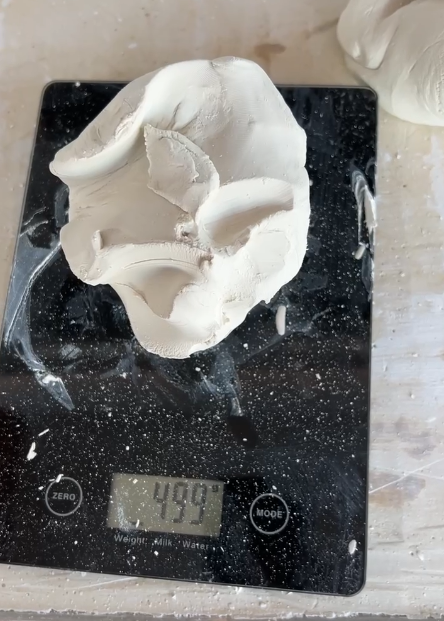
"How long is a rope". It all depends, but a rough guide is about 250 g of wet stoneware if you throw thin, around 345 g while you are still learning. If your bottom is too thick, then you need way more clay. That is a standard mug holding roughly 280 ml to the brim, body only. The handle comes from a separate lump.
Weights by size
Wet stoneware, thrown body only, 5 mm walls and a 6 mm base.
| Mug | Rim Ø | Height | Holds | Thin | Middling | Learning |
|---|---|---|---|---|---|---|
| Espresso | 58 mm | 55 mm | ~60 ml | 95 g | 115 g | 135 g |
| Small mug | 70 mm | 80 mm | ~150 ml | 170 g | 200 g | 240 g |
| Standard mug | 85 mm | 95 mm | ~280 ml | 245 g | 290 g | 345 g |
| Large mug | 95 mm | 105 mm | ~410 ml | 315 g | 370 g | 440 g |
| Tall mug | 90 mm | 140 mm | ~555 ml | 405 g | 475 g | 560 g |
These are for a fairly straight mug. A wide belly or a heavy foot will move them, so treat them as a place to start rather than a rule.
Why the learning column is higher
The clay in the finished mug is much the same either way. What changes is the clay that never gets there.
- Wall thickness. Much the biggest one. On a standard mug, pulling to 5 mm instead of 8 mm is about 90 g of difference.
- A heavy base. It is easy to leave 15 mm of clay under the floor without noticing, then trim most of it off again.
- Trimming. The more there is to take off, the more comes off.
- Slurry. What ends up in the water bucket over a session.
One way to use the table is to weigh out the learning figure and aim for the thin one. When your trimmings get smaller, move a column to the left.
Your mug is not in the table?
You can draw it in the Studio instead. It works the weight out from your own profile, including the wall thickness you set and the foot you trim, and gives you the capacity at the same time.
Clay for the handle
| Handle | Pull from | Ends up as |
|---|---|---|
| Small, espresso | 60 to 80 g | ~20 g |
| Standard strap | 120 to 150 g | ~40 g |
| Large or thick | 180 to 220 g | ~70 g |
You pull from more clay than you need because only the middle of a pull is usable. The top stays too thick and the tail goes too thin. The rest goes back in the bag, so it is not wasted.
Working it out for any pot
Clay weight is the volume of the clay itself, the walls and the base, not the volume the mug holds.
clay weight = wall volume × density × waste factor
wet stoneware is about 1.8 g/cm³ · waste is roughly 1.15 thin, 1.6 learning
Wall volume means the outside of the pot minus the inside, which is why wall thickness matters so much. On a straight cylinder you can estimate it as the surface area of the wall times its thickness, plus the base disc. Once the profile starts to curve, doing it by hand gets awkward.
A rough rule
For a normal mug with normal walls, wet clay in grams tends to land near 0.9 times the brim capacity in ml for a middling thrower. A 300 ml mug, call it 270 g. It is less reliable at the extremes, since small cups need proportionally more and large forms less, but it is close enough to weigh out with.
Wet weight and fired weight
Everything above is wet clay, which is what goes on the scale. The fired mug is lighter, since the water leaves during drying and firing. Expect somewhere around 15% lighter before glaze, so a 290 g mug comes out near 245 g.
Letting the tool do it
A table works for standard shapes. As soon as you design your own, with a belly or a flared rim or a trimmed foot, the numbers stop matching and you are estimating again.
The Jordsmide Pottery Studio works it out from the profile you draw. You can set the wall thickness at the rim and at the base separately, shape the trimmed foot, and pick your skill level so the waste allowance matches how you actually throw. It gives you:
- wet clay weight for your own shape
- capacity in ml, so you know it holds a proper coffee
- the size to throw it at, with shrinkage applied
- a 1:1 drawing to print and throw against
It is free, there is no signup, and it runs in the browser.
Get the weight for your own mug
Draw the shape and the weight, capacity and thrown size come out the other end. Nothing to install, no account, no ads.
Open the StudioCommon questions
How much clay for a standard mug?
About 250 g if you throw thin, around 345 g while learning, for a mug holding roughly 280 ml to the brim. Plus 120 to 150 g to pull the handle from.
Does that include the handle?
No, handles come off their own lump. A standard strap ends up around 40 g.
How much clay for a 12 oz mug?
12 oz of drinkable coffee is about 355 ml, which needs roughly 440 ml to the brim. That is around 290 g of wet clay if you throw thin, up to 400 g while learning. It is worth checking whether someone means usable or brim volume, because the difference is large.
Why are my mugs heavier than the table?
Usually wall thickness, and usually down at the base. Cutting a practice pot in half vertically shows you where the clay actually is.
Should I weigh the clay or judge by eye?
Weighing is easier while you are getting consistent. Your eye tends to come along faster when it has a number to check against.